
From Asia to Andalusia – the mango sailed around the world
The mango has been on an astonishing journey: the cultivated mango (mangifera indica) originally hails from South and South-East Asia, particularly the region between north-eastern India, Bangladesh and Myanmar. It first reached other tropical regions via trade routes and eventually made its way to the Americas. In the 20th century, Florida became a major centre for mango breeding – and it was there that some of the varieties we grow in Andalusia today were developed.
A key milestone in this history is the Mulgoba, an Indian mango variety that was brought to Florida at the end of the 19th century. A seedling from the Mulgoba gave rise to the Haden – a new mango variety that quickly gained recognition for its excellent fruit quality and adaptability, and became the starting point for a whole generation of successful Florida varieties. These include Kent, Keitt and Tommy Atkins, which are now among the world’s leading commercial varieties.
Our Osteen variety also has a very special history: in 1935, a seed from the Haden line was planted on the Osteen family’s property in Merritt Island, Florida. The tree that grew from it bore fruit for the first time a few years later – and gave its name to the variety.
Thus, the history of our mangoes leads from Mulgoba and Haden in Florida all the way to Andalusia – and today these special fruits grow right here with us, under the Málaga sun.
Not all mangoes are the same.
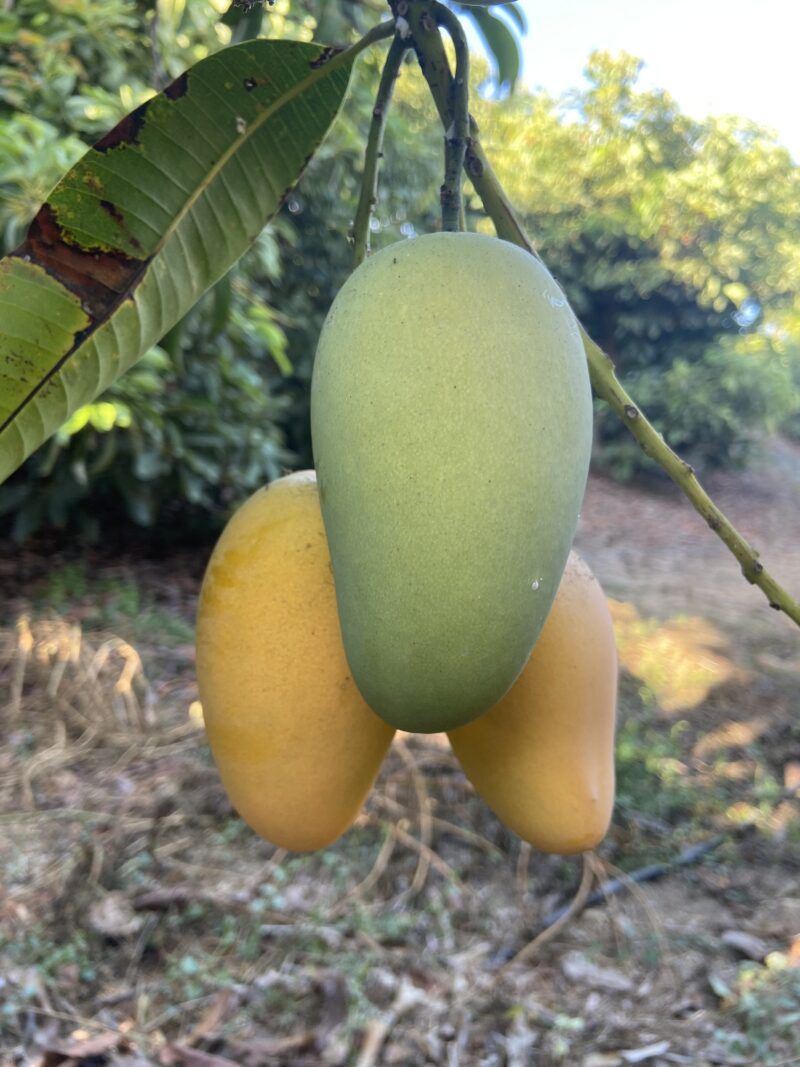
Anyone who has ever tried different varieties knows that colour, aroma, juiciness, sweetness and texture can vary remarkably.
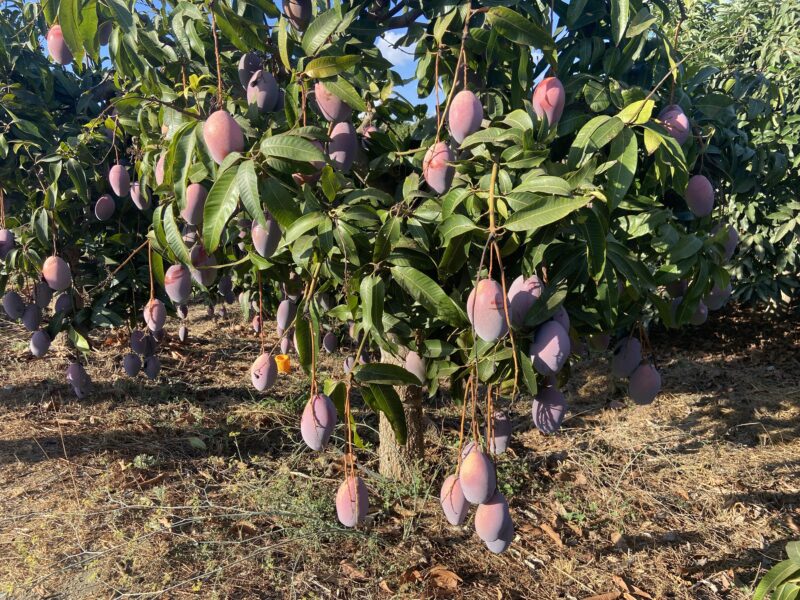
Tierra y Libertad’s mangoes are grown on the Costa Tropical, in the region around Málaga and Almunecar. As the name of the coast suggests, this is an area with perfect climatic conditions for (sub-)tropical fruit.
However, to successfully grow mangoes organically and sustainably, our producers Carlos Marquéz, Jesús Villena and José González cannot afford to overlook a thorough analysis of the conditions in which their trees grow. Each has developed their own methods, but they all share the practice of monitoring the health of the soil and the trees, as well as the quality of the fruit, on a daily basis, in order to ensure the responsible management of natural resources.
Biodiversity is a key factor on their farms in maintaining the health of their crops. Furthermore, by growing different varieties of mango, the producers are able to extend the season, which they supplement with other fruits such as avocado, medlar and cherimoya, which thrive in similar conditions and, thanks to their different ripening (and flowering – keeping our bee friends in mind!) periods, complement the mango well.
Our four varieties – Osteen, Kent, Keitt and Tommy Atkins – each have their own distinctive character. Here you can find out what makes them special and why Carlos, Jesús and Jose chose these particular varieties.
🥭 Osteen – The Andalusian
A true classic from Málaga.
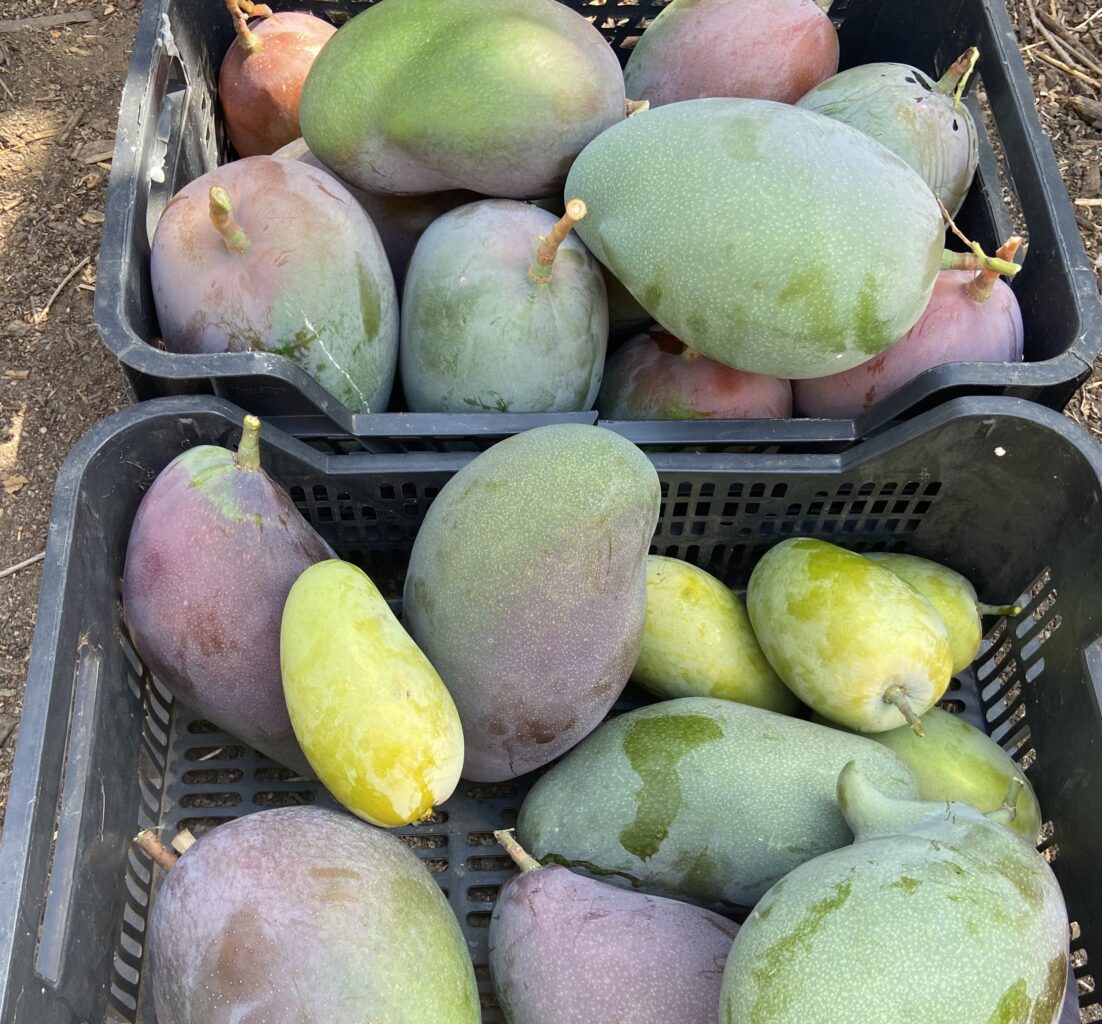
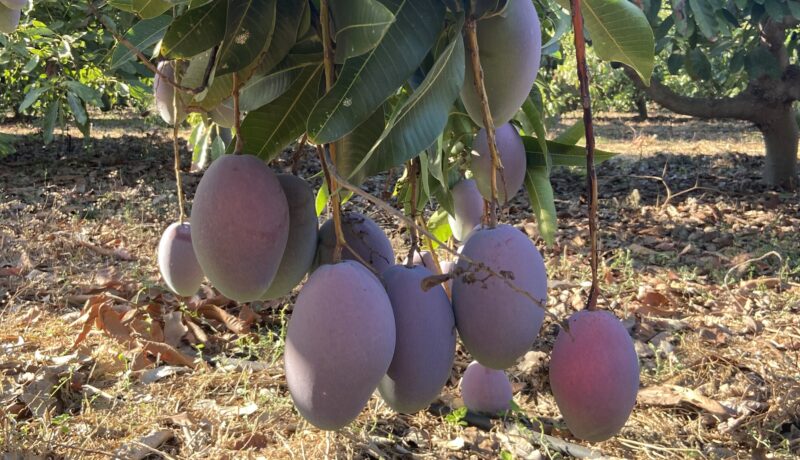
The Osteen is the most common variety of mango in Andalusia. This elongated, oval-shaped fruit is recognisable by its skin, which is usually purple to dark red, though it may also have patches of green, yellow or orange.
Inside, the flesh is juicy, aromatic and not very fibrous. The fruits are relatively large and, thanks to their tough skin, well suited to transport.
Flavour: balanced, aromatic, juicy
Harvest period: approximately September to October
Ideal for: anyone looking for a classic, aromatic Andalusian mango.
Its key advantage: the Osteen is perfectly suited to the conditions of southern Spain, where it has been successfully grown for many years.
Its slight drawback: as the Osteen is the main mango variety in Andalusia, it is very common. If you’d like to discover other flavours, we therefore strongly recommend that you also try our other varieties.
🥭 Tommy Atkins – The Robust Red
Remarkable, vigorous and particularly resistant to damage during transport.
The Tommy Atkins is easily recognisable: its skin is usually a deep red, often speckled with orange and green patches.
It is the earliest-ripening of our four varieties; in Andalusia, it is harvested from the beginning of August.
Its thick skin makes it very hardy and easy to transport. Compared to the Osteen, Kent and Keitt varieties, however, its flesh is more fibrous and its flavour slightly less refined.
Flavour: sweet and fruity, full-bodied, slightly fibrous
Harvest period: from around early August to late September
Ideal for: anyone who enjoys a firm, robust mango available early in the season.
Its advantage: it kicks off the regional mango season and is particularly well-suited to transport.
Its slight drawback: its flesh is noticeably more fibrous than that of our other three varieties.
” Hello friends, we at Tierra y Libertad would like to send you some summer greetings along with our mangoes. We’d like to remind you that the mango season will be starting soon – I think in about two weeks’ time. This mango we have here in front of us is the Tommy Atkins variety; it’s the first one, and it’s the one that allows us to bring the season forward and start eating mangoes. This variety is a sweet one; it’s characterised by having a slightly higher fibre content than the others – as you know, fibre is very important for our digestive system. We can also assure you that, based on the tests we’ve carried out, it tastes much better than, say, sauerkraut. So, very soon, very soon we’ll be starting with these delicious mangoes that we offer from here – from Málaga, from Andalusia. Best wishes, and I hope you continue to enjoy this hot summer. ”
🥭 Kent – The Sweet One
Juicy, sweet and particularly aromatic.
The Kent is a mid-season variety and is one of those mangoes that appeal above all for their intense aroma and very pleasant, low-fibre flesh.
The fruit is fairly rounded-oval in shape. Its skin has a greenish-yellow base colour with red patches.
The Kent is an excellent choice for anyone who loves mangoes primarily for their sweetness and aroma.
Flavour: sweet, juicy, intensely aromatic
Harvest period: approximately mid-September to mid-November
Ideal for: eating as it is, desserts, smoothies and anyone who appreciates a particularly aromatic mango.
Its key advantage: an excellent combination of sweetness, juiciness and a delicate texture.
Its slight drawback: the Kent is grown less widely in Andalusia than the Osteen and Keitt varieties and is therefore not always available.
🥭 Keitt – The Late Ripener
Large, juicy, aromatic – and available well into the mango season.
The Keitt is a distinctive mango, as it can still appear mostly green even when it is already ripe. On the side exposed to the sun, a pinkish-reddish sheen is often visible.
Its yellow-orange flesh is very juicy, firm and virtually fibre-free. Weighing around 500 to 600 grams, it is one of the largest mangoes.
And the Keitt is a late variety: the harvest season runs from around mid-October to early December.
Flavour: aromatic, juicy, slightly tangy and refreshing
Harvest period: from mid-October to early December
Ideal for: anyone who loves large, firm and particularly juicy mangoes.
Its advantage: the Keitt extends the regional mango season into autumn and impresses with the excellent quality of its fruit.
Its slight drawback: the Keitt requires a little more care when grown. In particular, it is important to manage flowering and fruit set carefully to ensure good fruit set and prevent the fruit from becoming too large.
WATER: E f f i c i e n c y before quantity
Mangoes grow in Andalusia, in a hot, dry climate – which is precisely what makes this region so ideal for subtropical fruits. At the same time, water is a particularly precious and limited resource there.
To produce high-quality fruit, targeted irrigation is necessary during the dry season. That is why Carlos, Jesús and Jose are focusing intensively on how to use water as efficiently as possible – with different approaches, certainly, but the same result: irrigation water usage has been significantly reduced thanks to the constant improvement in soil quality.
To give an example…

Through Jose’s finca runs a narrow irrigation channel ; it still carries a good flow of water even in the height of summer, and its use is regulated. When we visited Jose last year in September, following a long, dry summer, he had last watered the land 30 days earlier. Beneath the thick protective layer of leaves, the soil was nevertheless still moist, teeming with earthworms, and new chirimoya seedlings were beginning to grow under the leaves.
Jesús recently built a large water reservoir on his finca, for which he sacrificed numerous fruit trees. The benefit, however, is priceless.
Water consumption is officially regulated throughout the year with a consistent irrigation rate. This means that in winter, Jesús has more water available than he would need, whilst the same amount is, of course, no longer sufficient in summer. Thanks to the water reservoir, he can now save water in winter, supplemented by rainwater that is collected – so he has sufficient reserves for the dry summer.
Carlos, for his part, relies on plants such as vetiver, which not only stabilise the soil with their deep roots but also provide ground cover, as well as on microorganisms that enrich the soil and help the plant roots to absorb moisture and nutrients as effectively as possible.
The concept of ‘water productivity’ is particularly relevant in this regard: put simply, it describes the quantity of high-quality fruit that can be produced using a given amount of water. Irrigation trials carried out with Osteen in southern Spain show that reduced, targeted irrigation can significantly increase water productivity without a corresponding drop in yield.
For us, sustainable agriculture is therefore not simply a matter of
using as little water as possible. What really matters is
using the available water as wisely as possible
and producing as many high-quality fruits as possible.
How can you tell if a mango is ripe?
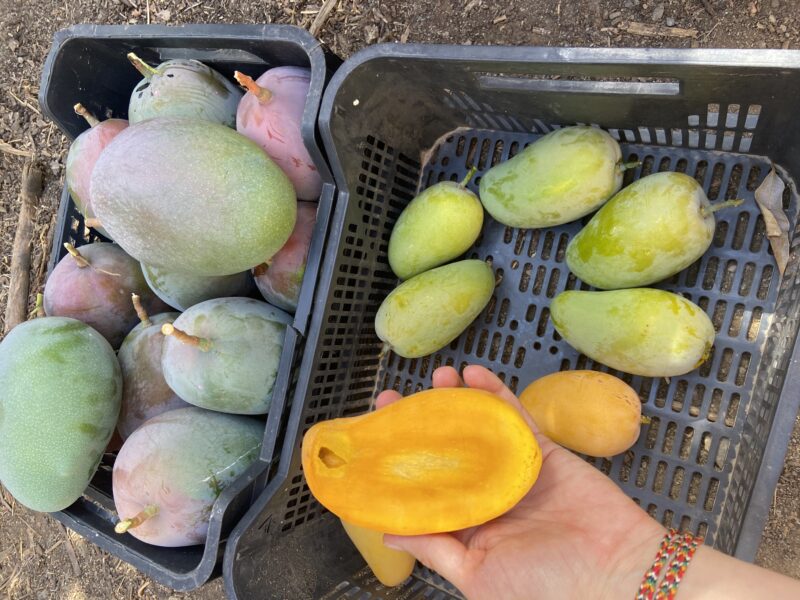
Don’t rely solely on colour!
For our mango varieties, the colour of the skin is only a limited indicator of ripeness. The Keitt, in particular, can remain mostly green even when ripe. The Osteen and Kent varieties may also have areas that are still green.
The pressure test is much more reliable than the look of the fruit:
Press very gently on the mango with your thumb.
If the fruit gives in slightly under pressure, it is generally ready to eat. If it is still very firm, it can be left to ripen for a few more days at room temperature.
If it is already very soft or shows signs of bruising, it should be eaten as soon as possible.
A quick tip for retailers: do not necessarily judge mangoes by their external colour, and advise customers to carry out the gentle pressure test. As always, patience is key when it comes to ripening. It is normal for the fruit to continue ripening after purchase.
Mango expertise, topic: propagation!
Who doesn’t want to grow their own mango plant at home! However, if you plant an Osteen stone, you’ll get a new seedling. The genetic makeup of your little mango tree is a completely new, unique combination. It may have interesting characteristics, but it won’t automatically be an Osteen again.
If, on the other hand, you graft an Osteen shoot onto a suitable mango rootstock, you’ll end up with an Osteen tree again – or, to be more precise, a clone of the Osteen variety growing on the rootstock’s root system.
Rootstocks are hardy mango varieties whose fruit may not be of commercial interest, but whose root systems grow quickly and vigorously, thus serving as rootstocks for the cultivated mango varieties to be grafted onto them. The fascinating thing is that the rootstock can certainly influence the tree.
For example, it can affect:
🌱 Growth vigour and tree size
💧 Water uptake and water balance
🧂 Tolerance to salt in the soil or irrigation water
🌿 Nutrient uptake
🍋 To some extent, yield and fruit size
🌳 Adaptation to specific soil and climatic conditions
Sign up to our Newsletter
We regularly post stories about the work of our members and the history of farming in Spain. If you would like to hear more of those stories, sign up to our email newsletter.
Before sending, please have a read of our privacy policy.
The Green Gold of Salty Soil
A brief lesson on mangoes

New product: ANCHOVIES!
Spring in the Guadalhorce Valley

Interview with Montse (Biovalle) on International Women’s Day 2026