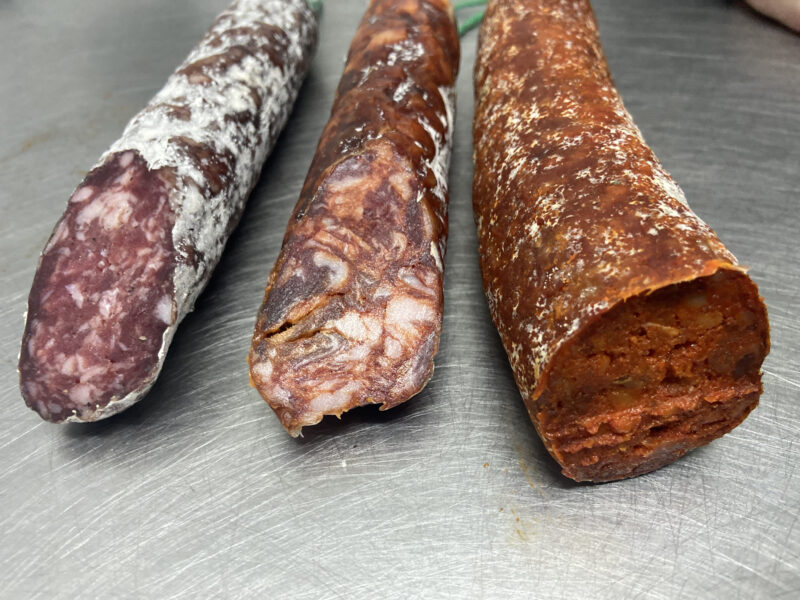
Project: Charcuterie
At Tierra y Libertad, our guiding principle is always the preservation of health—of the human body, the earth, and our social systems alike. We foster close relationships with consumers, which in turn enable our producers to create nutritious products while maintaining economic viability—without the use of chemicals, with respect for nature, and through sustainable, ecological methods.
In this spirit, a special project was established under the patronage of Tierra y Libertad, bringing together our producer Antonio Marín and The Food Hub, a dedicated small-scale wholesaler in Belgium. The result is a range of premium cured meat products, far removed from what is typically available in organic supermarkets and much closer to what traditional Spanish craftsmanship can create from the bounty of nature.
La Umbría & The Food Hub: Strong project, healthy product
Everyone knows the famous Spanish ham! It is a high-quality Spanish product, known and appreciated all over the world and—especially in its organic form—quite expensive. At the same time, ham production leaves behind a lot of pork offcuts, particularly large quantities of fat, which are usually turned into sausages.
This procedure has a long tradition in Spain, as seen in well-known products such as chorizo, salchichón and sobrasada.
In recent years, we have faced difficulties with the distribution of Antonio’s ham. Organic ham, produced using a sustainable rearing and processing system such as the one Antonio employs, is expensive, and this is reflected in the price. That is why, together with our partner in Belgium, The Food Hub, we came up with the idea of producing high-quality charcuterie instead of high-priced ham, using the whole pig, meaning much more high-value meat content in the sausages.
Two years ago, Antonio reserved 14 newborn piglets for The Food Hub for this exclusive production of cured sausages: chorizo, salchichón and sobrasada made from 100% organic pigs reared sustainably. These piglets are raised free-range in La Umbría, a 100 hectare farm with meadows, forests, mountain areas and (muddy) creeks moving around much more than in conventional or conventional organic farming, resulting in tender, mineral-rich, dark and flavourful meat.
The farm and its cycles
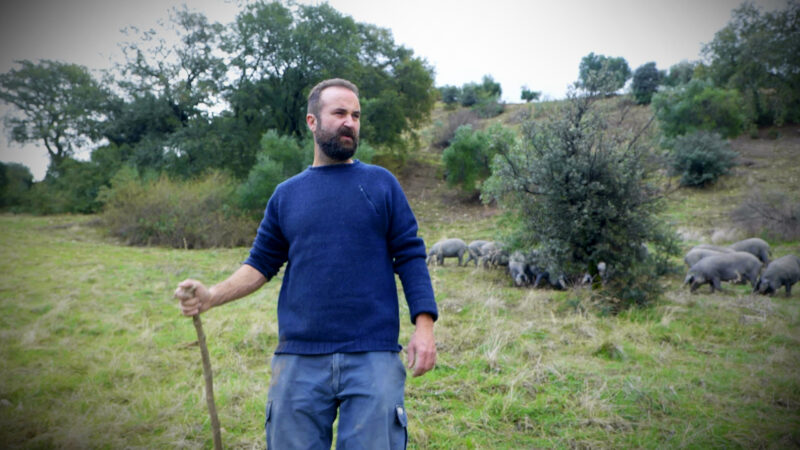
La Umbría has 15 areas which the animals explore gradually (taking between 20 days and up to 4 months, depending on the plot and the season). After the pigs, the sheep graze in the areas, and then the plot in question is left to rest, so that nature can recover. Sheep grazing has numerous beneficial side effects for the farm, such as regular fertilization and the consolidation of the topsoil against erosion, seed dispersal, fire control and grassland maintenance.
A pig’s life at Tierra y Libertad: natural and authentic
Growing up in a natural environment the piglets’ daily search for food allows them to experience the same emotions as a wild animal: hunger, adrenaline, herd instinct and territorial struggles. They mostly eat what the farm naturally provides: acorns, olives, figs, strawberry tree fruits, almonds, carob pods, grass and many aromatic herbs, as well as organic cereals during times of scarcity such as summer. Just imagine the flavour of this meat, nourished by the country’s abundance of fruit and herbs!
By way of comparison: the typical (and more expensive!) acorn-fed pig is fed acorns for just the last two or three months of its life (we call this period montanera because the pigs are free to roam the hills of the dehesa), having been kept in confinement until then. Antonio’s animals roam freely on his farm from the age of four months.
Locally manufactured and truly handcrafted
There’s mould in the air!
To this end, Antonio has also been looking for a new partner to process the meat of his pigs. Not far from our office in the Sierra de Aracena and Picos de Aroche he found a tiny factory, a small sausage-making business now in its third generation. They process even small quantities of meat for private customers – entirely organic, if desired. This region has a very long tradition in breeding iberico pigs as well as in curing ham and sausages. The most expensive iberico hams originate from these mountains.
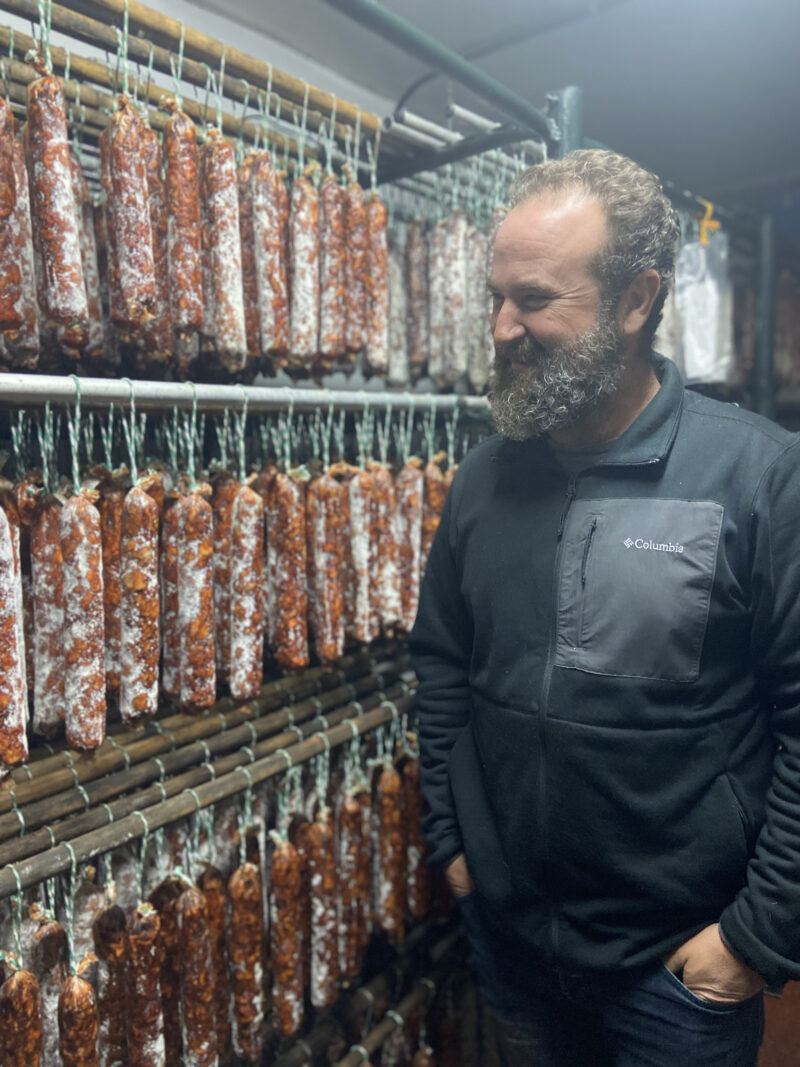
In addition to its long tradition, experience and specialist facilities, there is another distinctive feature: the mould that is used to mature the sausages (and hams) exists naturally in our mountains’ air. This mould is, in essence, a fermentation process that promotes the production of enzymes – in other words, aids our digestion – and makes the (naturally) preserved meat fit for human consumption, whilst imparting characteristic aromas and flavours.
Much like our natural processing of table olives, Antonio subjects the meat from his pigs to a purely natural maturing process. The recipe: meat, salt, rosemary extract – and time. It’s as simple as that. At the factory, the meat is minced in a single step, mixed with the relevant spice blend and shortly afterwards formed into sausages. For this, Antonio uses organic collagen casings, as they allow the sausages to mature evenly and facilitate the drying process that the sausage undergoes first. After one month in the ventilated drying room, the sausages are transferred for 2-3 months to the cellar, “la bodega”, where they ripen while finding perfect conditions for the mold to mature.
What we tend to eat without realising it…
Conventional industrial production of cured sausages such as salchichón, chorizo, and sobrasada often uses a combination of additives to improve shelf life, color, texture, flavor consistency, and manufacturing efficiency.
Industrial sausage production commonly relies on nitrites and nitrates (E249–E252) as curing agents and phosphates (E450–E452) as texture and water-retention enhancers. Although these additives improve shelf life and production efficiency, growing scientific evidence links frequent consumption of processed meats containing such compounds to serious long-term health risks, including colorectal cancer, cardiovascular disease, kidney damage, and chronic metabolic disorders. Nitrites can form carcinogenic nitrosamines in the body, while excessive phosphate intake is associated with vascular calcification and impaired kidney function. Beyond human health, the industrial production and large-scale agricultural use of nitrogen- and phosphate-based chemicals contribute significantly to water pollution, algal blooms, soil degradation, and the destruction of aquatic ecosystems.
… now, who wants to eat that?
In short: a traditional food has lost all its health-promoting properties in favour of a dubious shelf life. The animals live in poorer conditions, the producers earn hardly anything, the soil suffers, and traditional craftsmanship is dying out. Instead, on the shelves lies a product full of chemicals that harm our bodies and which, moreover, many people generally consider to be a poor product due to its harmful properties.
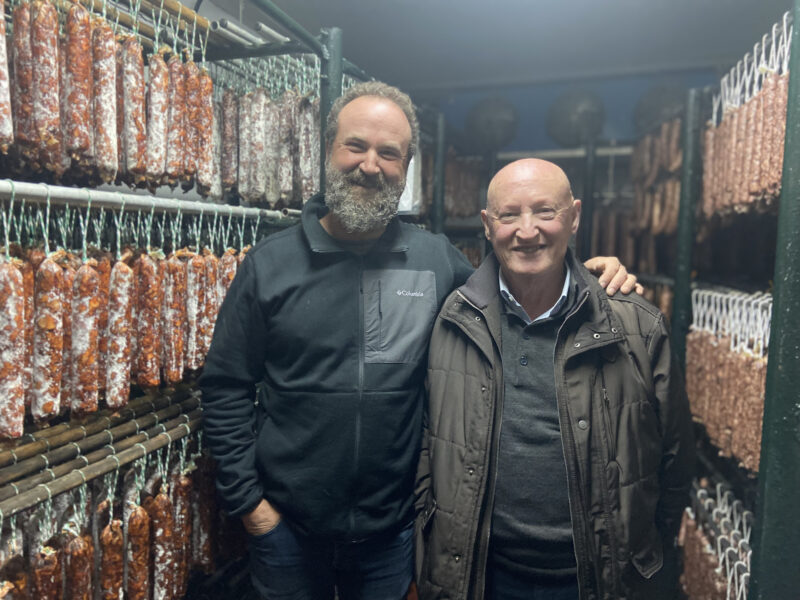
How we’re making charcuterie – and the world – a little bit better
About two years after initiating this collaboration between La Umbria and The Food Hub, we’ve tasted the first batch of salchichón, chorizo and sombrasada – all fully matured! What a taste explosion! Thanks to the significant increase in meat content, the charcuterie has much more body, the flavour is more refined, the fat content is balanced, and the taste of the succulent meat stands out more than the added spices. The result of Antonio’s efforts is a delicacy.
A rocky path we can only overcome together
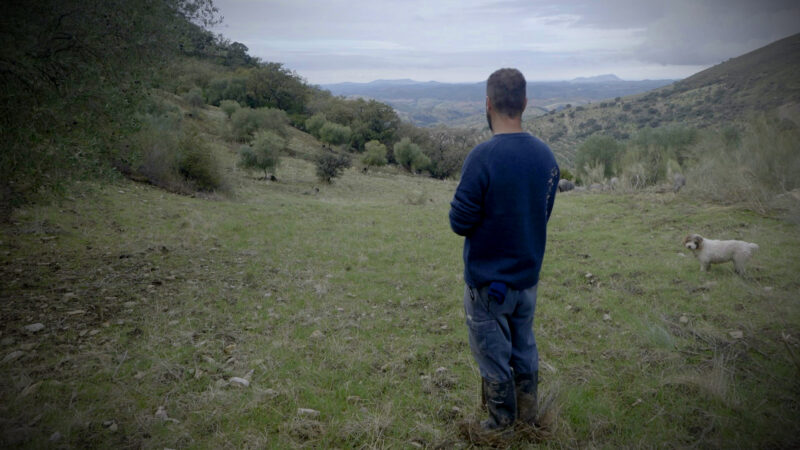
Anyone who chooses this path today – one that is sustainable, natural and eco-friendly – invests time, money and a great deal of passion into their work. There aren’t many farmers left who, beyond their convictions, are still willing to embark on this labour-intensive journey. We are happy and grateful that Antonio is here, and that The Food Hub, with all its clients, shop and restaurant owners, and ultimately everyone who, by buying and eating Antonio’s products, makes this return to mindfulness possible.
3 TRADITIONAL SPANISH VARIETIES OF CHARCUTERIE
Spain has a remarkable sausage tradition, shaped by regional identities, local climates, and centuries of cultural exchange. Three of the most iconic are Salchichón, Chorizo, and Sobrasada — each telling a different story about Spanish history and taste.
Chorizo is perhaps Spain’s most internationally recognized sausage and a symbol of the country’s bold culinary identity. Its rise is closely linked to the arrival of peppers from the Americas after the 15th century, which transformed Spanish cuisine and gave chorizo its famous deep red color and robust character. Every region developed its own style: smoky northern versions, rustic village chorizos from central Spain, and softer or spicier interpretations elsewhere. In many towns, annual pig-slaughter festivals turned chorizo-making into a communal celebration that brought families and neighbors together.
Salchichón is often considered the elegant, understated cousin among Spanish sausages. Traditionally associated with Castile and Catalonia, it became especially popular in rural inland communities where cured meats symbolized hospitality and prosperity. Its reputation comes from balance and refinement rather than intensity, and many villages still celebrate local varieties that have been produced for generations. Historically, salchichón was a staple carried by travelers and shepherds crossing the Spanish interior.
Sobrasada evolved from earlier Mediterranean traditions, particularly those of southern Italy and Sicily, where marinated raw sausage was also produced. In Mallorca, however, it found the perfect climatic conditions for its curing, resulting in a distinctive soft and creamy texture. On the Balearic island, its production is closely linked to rural life and the need to preserve food over long periods. Over time, it became an essential part of family celebrations and local festivals, particularly during the food-scarce winter months. Its creamier texture sets it apart from the cured sausages of mainland Spain and underscores its deep-rooted island identity. However, with the improvement of transport links and the boom in tourism in the mid-20th century, sobrasada became known beyond the islands and is now widely popular among the population of mainland Spain as well.